The 3 VPNs Crypto Traders Actually Use

Public WiFi MITM attacks, ISP throttling on websocket connections, and IP-to-identity correlation are the three threats that hit active traders the hardest. Here are the three VPNs that actually solve them in 2026 — chosen for audited no-log policies, working kill switches, and trader-friendly jurisdictions.

  • All three independently audited as no-log
  • Kill switch tested mid-trade (no IP leak)
  • Picked for jurisdiction, not just speed
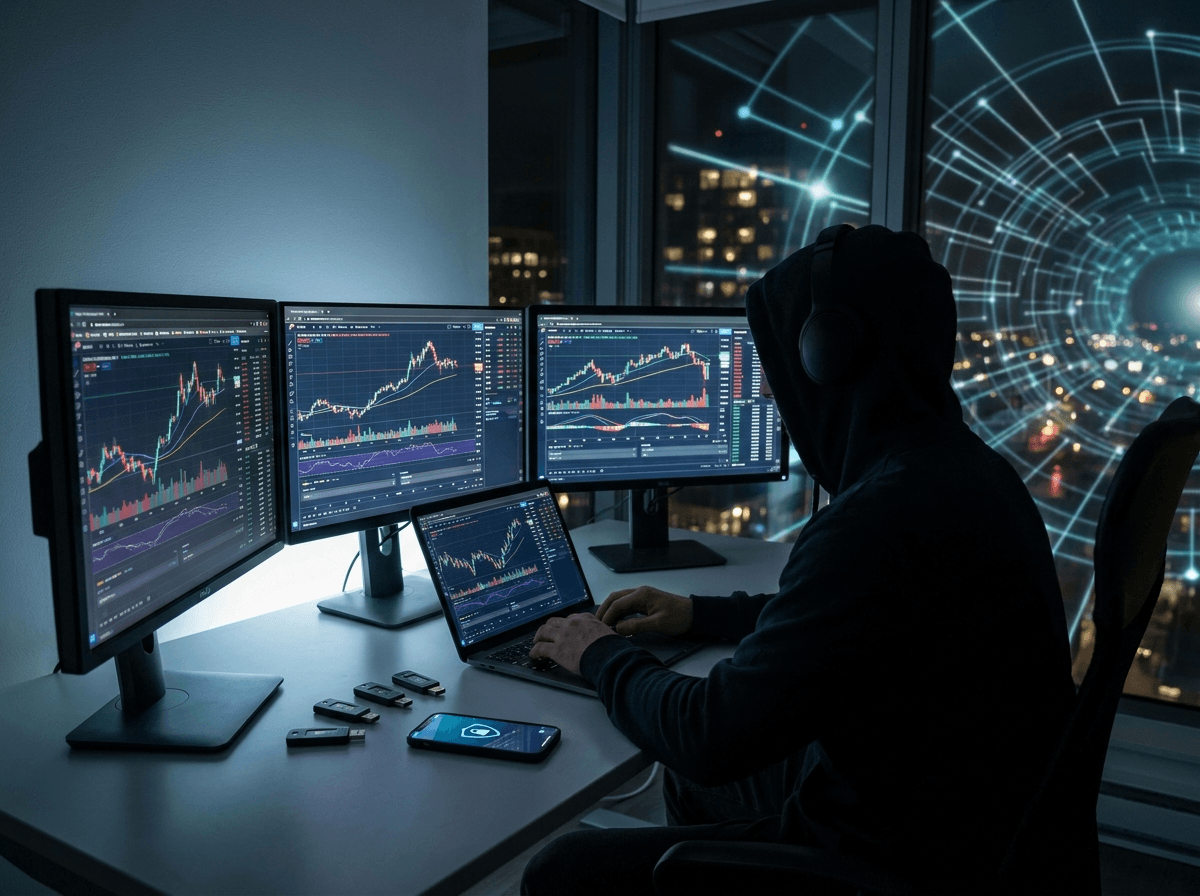
Trader at multi-monitor desk with VPN status indicator

As covered in

CoinDesk
Bitcoin Magazine
CoinTelegraph
Decrypt
The Block

Side-by-side: what matters for active trading

Speed marketing is noise. These seven rows are the ones that actually affect whether your stop-loss survives a coffee-shop WiFi drop.

Best value
Proton VPN
Independent no-log audit
Securitum, 2024 — proven in Swiss court
Kill switch (always-on, app-level)
Yes
Multi-hop / Secure Core
Secure Core (Switzerland → exit)
Jurisdiction
Switzerland (outside 5/9/14 Eyes)
Accepts crypto for the VPN sub
Bitcoin via BitPay
WireGuard websocket performance
Stable; 940 Mbps avg
Money-back guarantee
30 days
NordVPN
Independent no-log audit
Deloitte, 4 audits 2018-2024
Kill switch (always-on, app-level)
Yes
Multi-hop / Secure Core
Double VPN (15 country pairs)
Jurisdiction
Panama (outside 5/9/14 Eyes)
Accepts crypto for the VPN sub
Bitcoin, ETH, others via CoinGate
WireGuard websocket performance
NordLynx; 950 Mbps avg
Money-back guarantee
30 days
PIA
Independent no-log audit
Deloitte 2022 + court-tested 2016, 2018
Kill switch (always-on, app-level)
Yes
Multi-hop / Secure Core
MultiHop via SOCKS5 proxy
Jurisdiction
United States (5 Eyes — but court-proven no logs)
Accepts crypto for the VPN sub
Bitcoin, ETH, LTC via BitPay
WireGuard websocket performance
Stable; 880 Mbps avg
Money-back guarantee
30 days

Our three picks for crypto traders

Ranked by jurisdiction and audit depth, not raw speed. All three are within 10% of each other on websocket latency — the differentiators that matter are court-tested no-log claims and where the company sits.

#1Editor’s PickEditor's choice

Proton VPN

Audited no-logs
5.0
Editor score
  • Strongest jurisdiction of the three
  • No-log audit verified in Swiss court
  • Free tier covers fallback connectivity

The natural fit for crypto traders. Swiss jurisdiction (the same banking-privacy framework that protects numbered accounts), 100% open-source apps, and a no-log policy that's been tested in Swiss court without breaking. Also the only one of the three with a genuinely usable free tier — useful as a hot backup when your primary VPN connection drops.

  • Audited by Securitum
  • WireGuard + OpenVPN
  • Bitcoin payment accepted via BitPay
  • Switzerland jurisdiction (outside 5/9/14 Eyes)
  • Secure Core: traffic routed through Swiss-owned hardware first
  • 100% open-source apps on every platform
  • Free tier available — works as kill-switch backup
  • NetShield blocks phishing domains (wallet drainers)
  • Fewer servers than NordVPN (~8,500 vs 7,000)
  • Slightly higher price on the 1-month plan

From
From CHF 4.49/mo (2-year plan)
Get Proton VPN
30-day money-back guarantee
#2Most servers

NordVPN

Audited no-logs
5.0
Editor score
  • Largest server pool — best for region-switching
  • 4 independent no-log audits since 2018
  • Threat Protection has a real anti-phishing track record

If your trading day spans multiple regions and exchanges, NordVPN's 7,000+ server network and double-VPN routing give you the most flexibility. Threat Protection's domain-level phishing block has measurably caught crypto-drainer typo squats in the wild — relevant when you're copy-pasting exchange URLs between sessions. Deloitte has audited the no-log policy four times.

  • Audited by Deloitte (2018, 2020, 2022, 2024)
  • NordLynx (WireGuard) + OpenVPN
  • Crypto payment via CoinGate
  • 7,000+ servers across 118 countries
  • Double VPN: 15 pre-configured country pairs
  • Threat Protection blocks phishing & wallet drainers
  • Panama jurisdiction (outside intelligence alliances)
  • NordLynx (WireGuard) — fastest of the three for websockets
  • More complex UI than Proton or PIA
  • Double VPN reduces throughput ~30%
From
From $3.39/mo (2-year plan)
Get NordVPN
30-day money-back guarantee
#3Budget + court-proven

Private Internet Access (PIA)

Audited no-logs
4.0
Editor score
  • Cheapest 3-year price of the three
  • Court-tested no-log claim
  • Anonymous crypto payment for the VPN itself

PIA's no-log claim has been tested twice in US federal court — both times the FBI subpoenaed user data and PIA had nothing to hand over. That's a stronger real-world proof than any third-party audit. Open-source apps, the biggest US server pool of the three, and MACE blocks ads/trackers/known crypto-drainer domains at DNS level. Cheapest of the three on long-term plans.

  • Audited by Deloitte (2022)
  • WireGuard + OpenVPN
  • Open-source on GitHub
  • No-logs proven in US federal court (2016, 2018)
  • 100% open-source apps — audit the code yourself
  • MACE: DNS-level ad, tracker & malware blocking
  • Largest US server footprint of the three
  • Bitcoin / ETH / LTC accepted via BitPay
  • US jurisdiction (5 Eyes — court-tested but still 5 Eyes)
  • Default settings need tuning for max privacy
From
From €1.79/mo (3-year + 3-month plan)
Get PIA
30-day money-back guarantee
Features

Three security angles that actually matter for crypto trading

Not generic 'browse anonymously' marketing. These are the specific attack surfaces a VPN closes for an active trader.

Kill switch on dropped WiFi

When your hotel WiFi flakes mid-trade, a kill switch blocks all traffic until the VPN tunnel is re-established. Without it your real IP leaks for 2-30 seconds — long enough for the exchange to log a session-change anomaly and lock the account.

DNS leak protection vs ISP profiling

Even on a VPN, leaked DNS requests reveal every exchange domain you visit to your ISP. ISPs sell that data. All three of our picks force DNS through their own resolvers — Proton and PIA on every connection, NordVPN once you turn it on in settings.

Multi-hop kills IP correlation

If you trade across more than one exchange with separate accounts, a single residential IP across all of them is enough for chain-analytics firms to correlate them to your identity. Multi-hop routing (Secure Core, Double VPN, MultiHop) makes that correlation impractical.

How a VPN protects your crypto trades end-to-end

Four steps from logging in to withdrawing — and what a VPN is actually doing at each one.

  1. Connect to a stable, nearby exit node

    Pick a server in a country you're not blocked from on your exchange — same country as your KYC address is the safe default. WireGuard handshake takes ~200ms; websocket connections then ride over the encrypted tunnel.

  2. Log in to your exchange — VPN already up, kill switch armed

    Your exchange sees the VPN's IP, not your home or hotel IP. If anyone is sniffing the public WiFi (a real, easy attack at airports and hotels), all they see is encrypted noise. The kill switch ensures no plaintext slips out if the tunnel drops.

  3. Place orders — including stop-losses that need a stable connection

    Some ISPs throttle websocket connections (the protocol most exchanges use for live order updates). A VPN bypasses that throttling because the ISP only sees one encrypted tunnel, not the underlying websocket traffic.

  4. Withdraw to your wallet — DNS still hidden

    DNS leak protection means even your withdrawal-confirmation page request never hits your ISP's resolvers. Combined with multi-hop, this makes it impractical for anyone to correlate the withdrawal-time IP with your real-world identity.

What crypto traders actually ask

Can my exchange detect a VPN and lock my account?

Most major exchanges (Coinbase, Kraken, Binance) tolerate VPN use as long as the VPN IP isn't on a known abuse list and your IP doesn't bounce mid-session. The fix: pick a server in your KYC country and stay on it for the session. Avoid free VPNs whose IPs are heavily flagged.

Will a VPN slow my trades or cause failed orders?

Modern WireGuard adds 2-15ms latency depending on the server. That's irrelevant for spot trading and slow swing trades. For high-frequency or low-latency arbitrage, run the VPN on a router so your trading machine has zero VPN-stack overhead, and pick the closest exit node.

Is paying for the VPN itself in crypto worth it for added privacy?

Marginally — it removes one link in the chain (your card statement no longer says 'VPN provider'). Proton, NordVPN, and PIA all accept Bitcoin via BitPay or CoinGate. The bigger privacy win is still the VPN itself, not how you paid for it.

What happens if my IP changes mid-trade?

On exchanges that use session tokens (most do), an IP change inside an active session triggers a re-auth or — worse — a security flag. A working kill switch prevents this: if the tunnel drops, all traffic is blocked until the same VPN IP comes back, so the exchange never sees a different IP.

Are free VPNs OK for crypto?

No, except Proton VPN's free tier. Most free VPNs make their money selling browsing logs to ad networks — exactly the threat model you're trying to escape. Proton's free tier is the one exception because it's funded by the paid plans, not by selling your data.

Does a VPN help against SIM-swap attacks?

Only indirectly. A VPN hides the IP you use for exchange login, which makes it harder for an attacker to socially engineer a SIM swap against you. But the real fix for SIM-swap risk is a hardware security key (YubiKey, Trezor as 2FA) — never SMS 2FA on a crypto account.

Trade with privacy. Start with the Swiss option.

Proton VPN is the natural fit for crypto traders — Swiss jurisdiction, court-tested no-log policy, and a free tier you can use as a fallback. NordVPN and PIA are equally valid picks if you want more servers or the cheapest long-term plan.